Monday, April 7, 2014

Why the Roman Empire Fell.


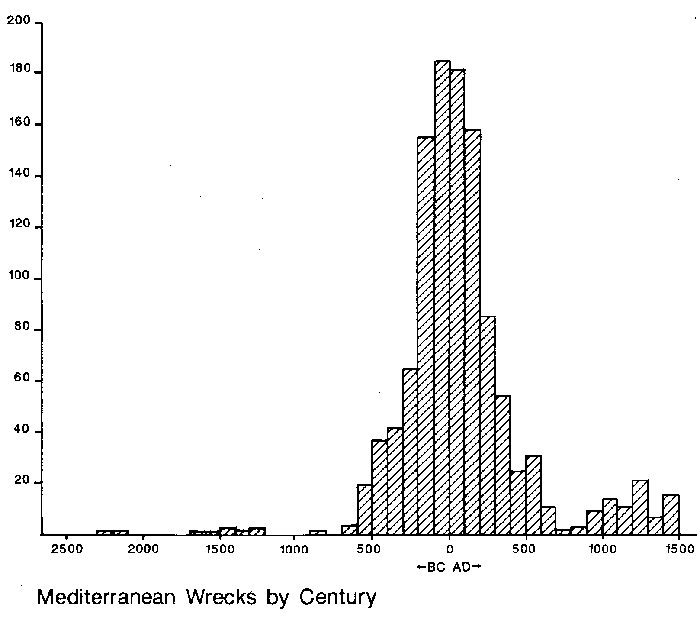
 This chart by Dr. A.J. Parker shows the number of Mediterranean shipwrecks by date of sinking.  The number of wrecks is proportional to the number of sailings.  And the number of ship sailings is a measure of economic activity, especially so in an age when everything moved by water. 
  Most interesting is the dating.  Notice the steady, almost exponential grow that starts 500-600 BC and keeps growing strongly until the first century BC.  About then, the Roman Republic came unglued and the Roman emperors, Julius, Augustus and company take over.  Notice also the decline in shipping that sets in at about the same time.  By the time we get to Constantine, commerce is down by two thirds from its peak.  In short, Constantine, who starts the retrenchment of the Empire, had only a third of the wealth to pay his armies and support his government that Augustus had at his disposal. 
   With this chart one can make a good argument that the freer and more democratic institutions of the Republic encouraged commerce and industry, whereas the policies of the emperors was hostile. It is generally agreed that the Empire fell when it was no longer able to pay the professional Roman Army that had kept the barbarians out for hundreds of years.  
  

Sunday, April 6, 2014

Fifty nervous heads, fifty loaded machine guns

Way back during the Viet Nam war,  I was assigned to a jet fighter wing in Thailand.  We were bombing North Viet Nam twice a day.  We had a poorly defended air base, lacking even a perimeter fence and about 5000 young airmen on base.  Some young troop wrote a letter to his Congressman saying "Here I am in a combat zone, and the Air Force won't let me have a gun."   In those days, Congressman spoke loudly AND carried a big stick, and so orders came down from AF HQ requiring every unit on the base to draw enough M16's out of base supply to arm every man in the unit.  More orders from the base commander, requiring each unit to build an arms room and keep the M16's locked up therein.  I remember taking the squadron pickup truck up to Base Supply and loading 400 brand new M16's, still in cartons, and 1200 new magazines, all full of ammo, and driving back to squadron headquarters,  feeling VERY well armed.  Meanwhile the men had built gun racks out of Dexion, and a gun room out of 3/4 inch plywood, and all the guns were safely locked inside. 
   And they stayed locked up for the rest of my tour at Korat Royal Thai Air Base.  And a good thing too.  I can still visualize the scene if we had been attacked and issued all those guns.  It would happen after dark, of course.  The troops would take shelter in the numerous sand bag bunkers we had in case of attack.  In each bunker you have fifty nervous troops, fifty nervous heads sticking up and looking all around, and fifty loaded machine guns.  These were the old style fully automatic M16s, pull the trigger and BRAP, 20 rounds are gone.  Sooner or later, someone's gun would go off, he forgets to put the safety on, he drops it, he's fiddling with it.  BRAP.  Over in the next bunker,  they hear the firing.  Someone shouts "They're over there, let 'em have it."  BRAP.  Someone else shouts, "They're shooting at us from over there."  BRAP.  I figure firing would continue until the last round was expended.  Should I have survived that night, the next morning would have been bad.  Bullet holes everywhere.  All the aircraft shot up.  All the hootchs full of holes.
  Fortunately it never happened, but it could have.
  So, when I hear that the military forbids the troops from carrying guns on base, I can understand where they are coming from. 

Silence gives assent

Something any candidate should understand.  If the opposition slimes you, you MUST reply.  The voters, most of whom have real lives to live, don't pay close attention to the political fray.  Many of them still make up their minds while standing in the voting booth.  When they hear an attack on a candidate, they assume it's just campaign skirmishing and don't pay much attention.
  BUT.  If the victim never responds to the slime, people begin to think "Gee maybe there is something in that slime.  If it wasn't true, he would have denied it.".
  Way back when, Mike Dukakis, governor of Massachusetts was running for the presidency against George Bush.  Willie Horton, an ugly convict, was out of prison, on some kind of parole, and he committed another atrocious crime.  Bush ran a bunch of TV ads claiming that the Duke was soft on crime.  Dukakis never said anything.  There were a bunch of things he could have said, but he decided to just say nothing. The mud stuck.
  Just last time, Obama accused Mitt Romney of being a blood sucking vulture capitalist, who bought of companies, laid everyone off, canceled their health insurance, and stole the office furniture.  Romney never said anything.  Romney should have said "At Bain capital we financed the start up of this company and that company and these other companies.  They are all still in business,  They are employing umpteen thousand workers, with health insurance, and a combined payroll of a many zillion dollars."  Romney didn't say a thing, and Obama's slime stuck. 
  And we are stuck with Obama for three more years. 
  Motto of the story, when they slime you, you gotta fight back.

Saturday, April 5, 2014

Turbotax

I hate doing my taxes.  Boring. And, the amount of money taken by Uncle Sam is always a downer.  And the mountains of paperwork, 1099, W-2, 140, Schedule A,B,D,E... X,Y,Z.  Aargh!
  For years I have been doing them with an Excel spreadsheet. But this year I gave up, I bought Turbotax, and got on with it.  I have to say, Turbotax reduces the pain enough to justify the program's cost.  It comes in four levels. Lowest and cheapest level only does fairly simple returns.  I had to buy level 3 ($90) before the program would handle the capital gains you get when you sell some stock.  The interface is pretty user friendly, like 100% better than anything you find in those IRS instruction sheets.  The program offers to download your 1099 forms from your stock broker, but for this feature to work you have to have "opened" a web window, complete with username and password into your stock account.  I never did that, fearing  hackers would get in and steal everything I own.  So I had to type in all the numbers from the 1099s.  But that's not too bad, I touch type, once it's down, you are golden.
  Turbotax urges your strongly to efile.  I don't, 'cause when you efile, your return can go right into the IRS computers, and if you screwed up, those computers will be on your case for more money quicktime. If IRS has to hand key your return into their computers, or even just run it thru an optical scanner, they may not bother if your return looks reasonable.
   Don't ask Turbotax to "print" your return.  When I did so, it printed out 44 pages of return and then fell into a loop printing page after page of pure gibberish.  Instead ask Turbotax to make a pdf file of your return.  Then print it out using Adobe.
   Turbotax understands all the obscure extra forms that you can file to get little tax breaks here and there.  It did a couple of forms I'd never seen before and saved me bits and pieces of money.
 

Why Nations Fail by Daron Acemoglu & James Robinson

The title is intriguing.  Does this book reveal the secrets of national economic success?  Point out things that lead to national poverty?  Read on.
  It is an infuriating read.  Glittering generalities, vague language.  Few real examples.  Some of the few examples given are plain wrong.  Other examples are taken from obscure times and places unfamiliar to all but a few specialists.  The authors settle down to condemning "extractive policies" and praising "inclusive policies" without either defining these ideas or giving many examples.  They do tell us how the Spanish Conquistadors stuck it to the conquered Indians, but that is about it for examples.  They speak disparagingly about Jared Diamond's theory but it is clear that they don't understand what Diamond was saying.  They claim the English Civil War was a turning point that set England upon the course to the industrial revolution.  But they don't discuss the sides, the issues, the winners, the losers, the connection with the industrial revolution, or the outcome.  
   The thesis of the book is that national wealth or poverty is determined by government policy, but things break down there.  "Inclusive policies" adopted by governments lead to wealth, extractive policies lead to poverty.  Which sounds like  " The gostalk distims the doshes" to me.  The best examples given are the two Korea's, and an obscure town on the US-Mexican border.  With the same history, geography, natural resources, ethnicity, North Korea lives in poverty whereas South Korea is one of the richest nations on earth. The only difference between North and South is the government.  The border splits Nogales in two, the town on the US side is healthier, wealthier, and better served than the town on the Mexican side.  All of which is well known and obvious, but no details are given.  What specifically makes the successful ones successful.
   One of the authors, Robinson, is a Harvard professor, the other ,Acemoglu, is an MIT professor.  I don't expect much of Harvard professors, but I am disappointed that an MIT faculty member would put his name to such an unsatisfactory piece of writing.

Friday, April 4, 2014

Ivan Lopez?

How does a man get a Russian Christian name and a Spanish surname?  The newsies haven't looked into this at all.

Thursday, April 3, 2014

Jeanne Shaheen casts 96 votes so far this year

That's about one vote a day.   Actually the Senate has this quaint custom of requiring two votes on every issue.  First they vote to take a vote, and then they vote on the issue.  So less business than you might think got transacted.  So what did our democratic senator vote for?

Top vote getter, with 55 voters, was nominations.  Judges mostly but some administration appointees like Janet Yellen for the Federal Reserve chairman.   The rest of 'em were just middle weight judges for all over the country.  The constitution does require the "advise and consent" of the Senate for judicial appointments, but I never expected anything like that number of judges.

Next , there are the 9 votes cast to extend unemployment benefits beyond two years.  Used to be, un employment only lasted a few weeks to tide you over til you found a new job.  Now it runs for two years, and Jeanne voted 9 times to make it even longer.

Then there a 8 votes for the "doc fix".  Some years ago, Congress voted a sizable cut in medicaid/medicare rates.  The doctors all screamed.  Rather than repeal the cuts for good, Congress votes a postponement of them, every year.  Nothing is ever really final in Washington.

Then we come to 8 votes for mystery bills.  The website said "No short title submitted for this bill".  So it could be anything.  The Senate should never pass a mystery bill.  If we don't even have a title, it could be anything, and is probably harmful.  Jeanne voted for these concealed time bombs 8 times.

And now we get to flood insurance.  Private companies refuse to write flood insurance because it's a loser.  Everyone knows which land will get flooded and which won't.  Homeowners liable to getting flooded buy flood insurance. Homeowners on higher ground don't.  All flood insurance policies have to pay off after the flood happens.  In response to the cries of owners of waterfront property, and realtors, and mortgage lenders, Congess passed a federal flood insurance plan years ago.  You can buy flood insurance from the feds, the premiums aren't cheap, but the coverage is first rate. And Uncle Sam looses barrels of money after every flood.  It got so bad, that the Biggert-Waters reform act was passed in 2012 to try and limit taxpayer losses.Since nothing is ever final in Washington,  the flood insurance lobby keeps bringing up bills to repeal Biggert-Waters.  Jeanne Shaheen voted for Biggert- Water repeal 4 times.

And we have 4 votes in favor of assorted waivers to Obamacare. Three votes in favor of reforms that are supposed to do something about sexual assault in the armed forces. 2 votes in favor of the farm bill, and a single vote each for Ukraine aid, raise the federal debt limit, and to kill parts of the Budget Control Act.

So.  We have 55 votes for democratic judge nominees, 27 votes that give taxpayer money away, 8 mystery votes, 6 miscellaneous votes.

Scott Brown is looking better and better,